Wednesday, March 6, 2013

Another sold out Collection!

On Tuesday Concord Music Group/Rounder Records released a limited edition
(10,000 units) of the Duane Allman 7 CD retrospective collection.


(Please read today’s FREE Golden Nugget marketing idea at the end of this email !!!..)

We love collaborating with CMG; from the McCartney RAM project you’ve seen
in the past to this Duane Allman collection, CMG is giving fans and collectors value.

There are 6 classic rock releases this month. I want to review some numbers
with you for sales comparison:

3 releases are a single CD. (Hendrix, Bowie and Clapton)
3 releases are box sets:
* Eagles (Elektra/Asylum): 6 CDs on Amazon for $28.00
* Stills (Rhino): 4 CDs on Amazon for $44.00
* Allman (CMG/Rounder): 7 CDs on Amazon for $117.00 (retail $140.00)

Clearly CMG knows well executed limited editions command a significantly higher price point.

On to the specifics about this package. As you review the CMG unboxing video below, you’ll see the various elements that were added to enhance the package.

The package starts by opening the shrink wrap with an “onsert” explaining the contents.

* Outer box is litho printed and turned edge construction including a scuff free film
lamination.
* Inside is a gold crushed velvet that simulates the inside of a guitar case.
* A 72 page + cover perfect bound book (PUR glue binding btw!).
* Sky Dog sticker printed on vinyl using UV inks (suitable for car bumpers).
* Fender medium pick. I guess CMG felt a metal slide would be a bit over the top.
* The video doesn’t show the two “pull” ribbons that help release the 7 CDs.
* Individual CD sleeves are designed to look like guitar string packaging and they do! 7 different colors (via 4CP) on a translucent vellum.

The booklet, sticker and onsert were printed here; the outer box and sleeves were produced at ICLA’s overseas factory. All the components were delivered to Terra Haute (Sony) for final inserting and fulfillment.

http://y2u.be/EtSpjEsXnHs

PS: Concord Music Group uses their promotional YouTube channel to effectively market the Duane Allman package. 11,000 views in a week. Electra/Asylum doesn’t have a YouTube channel....Can your product be effectively marketed on YouTube?
Something to consider.

Monday, February 11, 2013

See us at the Grammys?

If you watched the Grammys on Sunday night I’m sure you heard a variety of songs, singers young and old and of course selections of music to suit tastes of all kinds. My favorite moment: An entire ensemble performing The Band’s “The Weight”. Which was your favorite?

What you didn’t see is the presentation of the Grammy for best boxed or special limited edition package (#63)OR best historical album (#65). Although twice nominated, our package, RAM-Paul McCartney Archive Collection (Concord Music), didn’t win a Grammy. You can see some of the images of the package below. At the end of this post, there is a link to our website for more images and a video of the unboxing with McCartney music in the background.


Here are a few facts: We produced in excess of 20,000 units and the entire package is currently available on Amazon.com for $77.00. The construction of the outside box is one of a compartmentalized clamshell using turned edge fabric. The fabric matched the preceding McCartney Archive books. I really like the realistic photo images (made from a stone based paper with a thick clear UV coating). Everyone’s favorite part of the package (besides the music) is the simulated hand written notes that Paul used to compose his thoughts and lyrics. We used several types of paper, all folded differently. They look like the real thing!

This project has it all; hand work, intricate printing, tight turned edge construction, unusual materials, different binding methods and some serious responsibility. We produced this package overseas, on budget and on time to three worldwide disk replication factories for final assembly (Japan, Germany and the US). If you have a complex project and need a trusted partner, look no further than Integrated Communications Los Angeles.

http://www.icla.com/paul_mccartney_RAM.php

Of course if you are a serious McCartney fan, you need to own this collection.

Thursday, January 31, 2013

Tension frames for graphic images

The image below is a project we finished a few months ago.


I want to call your attention to the clean style a “tension” type aluminum frame presents.
The frame holds the printed flexible vinyl print. This project is 16’ x 8’. The new tension
frame is attached to an existing plywood board and angle iron frame assembly.

(a before picture is also below).
I like tension style frames for several reasons:

* Once the frame is installed, the vinyl can be changed out quickly and
inexpensively to promote your seasonal message.

* Tension frames are available in a framed (shown) or frameless style depending on your
location’s needs or preference.

* The vinyl is stretched taut and presents a smooth clean surface
much like a drum surface. No wind gets behind the print;
the image remains stable and smooth.

* If your company has a maintenance crew available; a print change-out is easy to perform
once the frame has been installed. Or we can do the change out for you.

* Seasonal messages can be removed, cleaned and stored for reuse the next year.
Once you have an inventory of seasonal messages, your marketing efforts are much more
flexible and your costs drop substantially.

* The frame is custom trimmed to fit your installation size requirements.

* Tension frames can be installed indoors or outdoors.

Before:


Here is a sample of a frameless style installation:

Friday, January 4, 2013

USPS Changes the rules for self mailers

As of January 5, 2013:
CHANGES TO SELF MAILERS The United States Postal Service (USPS) will begin enforcing new design rules for "Letter" sized Self Mailers (THIS DOES NOT INCLUDE "Letter" sized envelope or postcard mail pieces).

A letter sized "Self Mailer" is a mail piece that has a fold (usually at least 2 even sized panels) and is not placed into a paper/poly envelope.


The main changes are as follows:
Old Max Size: 6.25” x 11.5”
New Size:
Minimum Size for letter size Self Mailer is now 3.5” x 5”
Max Size for letter size Self Mailer is now 6” x 10.5”


Final Fold/Spine: The final fold, when looking at the addressing area, NEEDS to be on the bottom or leading (right side) edge.

The FINAL FOLD CAN NO LONGER BE ON THE TOP WHEN LOOKING AT THE ADDRESS PANEL. If the following specs are not met, a non-machineable surcharge of $0.20 per piece will be charged in addition to the regular postage amount.

As of January 28, 2013:

POSTAGE INCREASE The USPS will raise postage rates again on January 28, 2013. For reference, a First Class single piece rate will now be $0.46 each. As for PreSorted Rates and Standard Class rates, postage rates are increasing by an average of 2.57%.

For more information about postage rates, please contact me.

Tuesday, October 30, 2012

Label basics

Basic label terminology:

The term “pressure sensitive” (when applied to labels) means the label has an adhesive that will adhere to a surface when downward pressure is applied. This type of label is also known as “self-adhesive”. I won’t be discussing C1S paper labels using water based glue (think Campbell’s soup can).

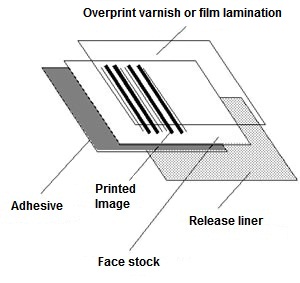
The majority of pressure sensitive (PS) labels utilize the following construction:


An over print varnish (OPV) or film lamination is used to protect the printed surface of the face stock and increase the label’s lifespan. OPV is traditionally a UV liquid applied in-line during the printing process. OPV can also be applied off-line depending on the selected production process. OPV patterns can also be applied via the silk screen printing process (although more expensive) and provide a unique textural feel to the label.

Overall film laminations can be applied to the printed surface of the face stock to further increase the life span of label or protect the face stock from high wear environments. An example might be an outdoor safety label exposed to the elements, a team label for football helmets, or a label used in long term POP retail displays. Film lamination is more expensive than UV top coating, but you have more choices for surface, thickness and substrate selection.

The face stock is the “backbone” of the label. It’s the material you see after the label has been applied. There is a huge selection of face stocks available; however the most common are coated paper, vinyl, polypropylene and polyester. Face stocks are also available as an uncoated substrate mostly for wine bottle and retail food products. The face stock that is removed during the manufacturing process (leaving just the printed label) is called the matrix. The matrix is almost always removed for labels destined to be applied using high speed automatic equipment. Below is an image of the matrix being removed from the roll:


The underside of the face stock is the adhesive (pressure sensitive adhesive, PSA). There are approximately 10 common types of adhesives used for PSA’s; although not all PSA’s are available on all substrates. Adhesive performance ranges from permanent, hi-tack permanent, removable, to re-positionable. Their chemical content ranges from rubber, acrylic to silicone. Specialty usage can be all-temperature, cold-temperature, and even an ultra-adhesive for low surface energy plastics. The usage, the face stock and the adherent all play a factor in determining the optimum adhesive for the application.

The liner (backing) acts as the carrier for the die cut label. The liner has a coating which allows the liner to cleanly release (aka “release liner”) from the face stock. This coating is most commonly silicone. Types of liners include SCK (super calendared kraft), PK (poly-coated kraft), LF (lay flat), PET (polyester) and BG (bleached glassine).

SCK: low cost, general all around liner for paper materials. Poor lay flat and moderate particulate levels.
PK: improved die cutting, handles deep die cutting better than SCK. Slightly lower particulate levels. Does not sheet well.
LF: excellent stability and resistance to curling. Best for sheeted label applications.
PET: durable and good for high speed die-cutting. Poor sheeting. Very low particulate levels (think clean room and pharmaceutical usage). Higher cost than SCK or PK.
BG: low cost, low to medium speed dispensing. Poor sheeting characteristics.

Delivery: Labels are generally die cut using a low-cost magnetic die, a steel die or a router based cutter for short-run digital labels. Your label manufacturer stocks a large variety of common shaped/sized “tooling” for producing labels. A magnetic cutting die is pictured below:


Not all substrates can be cut using inexpensive magnetic dies, and in those cases a more expensive steel die is required. As the run length increases (or the possibility of a reprint increases), a steel die investment becomes a conversation you need to have with your supplier. A steel die is pictured below:


If your label has any size flexibility, you would be wise to consult with your label supplier to determine whether a very small size change can affect or eliminate the tooling cost of the die.

Most labels are produced on rolls and applied using automatic affixing equipment. This is the most cost effective way to manufacture your label and almost all label printers use a roll-to-roll printing press for this type of production. If you are using automated equipment to apply your labels to the product you’ll want to specify the printed image orientation on the roll.


Above is a typical label position chart that shows how your label might be applied onto the finished product. You can see if you select the wrong position, your label may not be applied properly and the warehouse will not be happy campers.

For projects requiring labels to be sheeted, a “sheeter” tool is required. For shorter run labels, fitting the label to a larger sheeter tool will increase your material cost but eliminate the tooling cost. As the run length increases, an optimum sized sheeter tool becomes more cost effective and reduces your materials cost.

Labels printed on vinyl (PVC) are water proof, widely available, inexpensive and adhere well to unusual shapes. Unfortunately PVC is not recyclable and the chlorine component contributes to ozone depletion. The better alternative is polypropylene (PP). PP is recyclable, prints sharper than vinyl, and is cost effective against vinyl. The PP thickness choices and availability are still catching up to the more popular vinyl, but if you are looking to reduce your PVC usage in your supply chain, you should be considering PP.

Tuesday, July 17, 2012

Which is the best glue for Perfect Binding: Hot Melt or PUR

Many of you will recognize the binding style known as “perfect binding” or “adhesive binding”. Still fuzzy? The binding with the square spine (see attached image).


This type of binding is great for consistent page size, large page counts, mixing different paper types and a strong attractive finished product. It’s been the dominant binding method for annual reports and used for years on magazines like National Geographic and Vogue.


Specifying the right type of glue for your project is one key to meeting the clients expectations. There are two primary types of glues used for perfect binding: EVA (ethylene vinyl acetate) and PUR (polyurethane reactive); both are holt melt types. Which should you specify?


EVAs or hot glues were the original glues used for perfect binding. They have been around for many years, are inexpensive, cure almost instantly, and form a strong bond under most conditions. They do not hold up well in extreme temperatures and tend to crack as a result when too cold, fall apart when too hot or crack when overstressed. Hot-melts should be avoided when working with heavy coated stocks, stocks over 70# in weight, or finished products that will be exposed to excessive heat or cold weather. Expect the book to fail if you keep it in your car during a Palm Springs summer. Most monthly national publications use hot melt glue for economy…..of course they are using lightweight coated paper.


EVA hot melt glues are a good choice for binding uncoated paper (60# and lighter), economical short runs and very thin spines (provided the binding is supported with side stitching). The cost to bind a short run catalog with EVA hot melt is MUCH less expensive than the setup costs for the bigger PUR glue binding lines. BUT be aware the client needs to understand the tradeoffs of an economical EVA hot melt product as opposed to the superior features of PUR glue. EVA hot melt glues are very popular on the short run small foot print binding machines (Duplo or Horizon) found in smaller binderies and in-house operations. (inexpensive Duplo machine below)


PUR glues came along in the early 1990's; they seemed to answer many of the challenges inherent to perfect bound books: primarily flexibility, layflat qualities, and durability. Technically speaking, the polymers in PUR adhesives cross-link onto the stock via a chemical reaction with MOISTURE, thus facilitating adherence, increasing pull strength, providing greater resistance to hot and cold temperatures, and reducing waviness in wrong-grain projects. They have made an incredible impact on the perfect binding industry.


The market for PUR glue was originally driven by products such as software manuals, reference books, and high-end catalogs and now includes hard-cover books, catalogs, and annual reports. Check out the following advantages of PUR glue, as described by one chemical supplier:


1. Heat Resistance - Perfect bound materials hold up in temperature ranges all the way up to 200F. Conventional hot melts generally fail at 120F or less.

2. Cold Resistance - PUR does not fracture at temperatures as low as minus (-) 45F. EVAs are generally flexible to plus (+) 25F.

3. Adhesion - Because of their chemistry and molecular weight, PURs are formulated to adhere difficult stocks. This is particularly important in jobs with heavily coated stocks against the grain, traits common to annual reports, for example.

4. Flexibility - Books bound with PUR glue have excellent layflat qualities. The adhesive is very pliable, and less of it is required on the backbone. This is perhaps the most appealing aspect of PUR glue. Not only does it answer the problem of books that snap shut, or the "mousetrap" effect as it is called, there is far less unsightly glue seepage into the spine of the book.

5. Ink Solvent Resistance - PURs are virtually unaffected by the migration of printing ink vehicles. (PUR adhesives will not dissolve with exposure to things such as alcohol, toluene, and gasoline.)

6. Durability - All of the aforementioned benefits provide the printing industry with a ten-fold improvement in durability. Books destined for a long life or heavy use will retain their integrity. Durability is one of the premier reasons PUR glue has been such a success. In the past, perfect bound books were notorious for their lack of strength and durability over time. Now, even high-end catalogs that were previously sewn hold up well using PUR adhesives. Both page pull tests and flex tests measure substantially higher in books produced using PUR glue, with page pulls that average up to 40 to 60 percent better than with traditional adhesives.
There are many considerations when choosing an adhesive. As with any product, PUR glue has its limitations. It’s more expensive than traditional glues making it cost prohibitive for certain jobs (monthly publications). [PUR glues require special equipment as the adhesive cannot come into contact with air during application. It’s not simply a matter of changing the glue.]

Other downsides to PUR glue include the extra curing time necessary for acceptable handling because of the high moisture content necessary to activate the adhesive. PUR bound products should be lightly handled for the first 24 hours. PUR achieves 95% strength within 24 hours and therefore needs to remain exposed to natural air; it further cures over 72 hours. Post binding services, such as drilling, will need to wait 24 hours until the glue has a chance to set up. This adds time to your schedule.


Large Perfect binding line


Whether PUR adhesives are right for a given job is contingent on several factors: the life expectancy of the book, the end-use, and the budget. My best advice is to be diligent about discussing these details before producing the job.


PS: One of my vendors is installing a new 20 pocket PUR machine this week. The HOT new feature on this machine is “optical image recognition” which insures sequential signature positioning and results in error free production! It's the only one of its kind on the West Coast. If your books or catalogs require rigorous QC inspection upon arrival, you need to be using this equipment. Ask me for details.

Monday, July 2, 2012

Lightjet Prints for the Ultimate in Reproduction

If you are looking for the ultimate in superb digital reproduction quality, look no further than LightJet. Lightjet prints are the premier choice for producing high quality wall art, murals, retail signage, tradeshow graphics, corporate entry graphics and portrait photos. The hardware exposes digital images to photographic paper and film (rather than an inkjet printing process); the result is a photographic continuous tone rather than halftone dots which are common on offset press or ink-jet. True continuous tones are not possible with images printed using ink or pigments.


Lightjet exposes silver-halide photographic paper using three digitally controlled lasers (red, green and blue laser light) onto the photo-sensitive emulsion on the paper medium (or back-lit transparency substrate). The print is then processed using traditional photochemical means. After which, the photographic print is handled just as any other photo-print.


Lightjet natively supports RGB raster files. The 24 bit color continuous-tone device uses a large multitude of colors (up to 16,777,216) rather than the small number of colors available to 4-color press and 8-color ink-jet type devices. With a file of good integrity, posterization and banding are unlikely.


Our LightJet can image a 50" x 120" area. Prints are economically priced, and in larger quantities are less expensive than comparative inkjet printing. Lightjet photopaper is more fragile than traditional inkjet and therefore must be protected after imaging. A wide variety of photographic papers are available in gloss, matte, and supergloss. In addition, special metallic paper can be used to give your digital photo art a distinctive look. Also available are back-lit materials such as Duratrans and Duraclear transparencies.


My favorite mounting option is acrylic, providing a stunning smooth face surface. Acrylic comes in several thicknesses and depending on the size of the print, you’ll want to select a thickness that will look great given the final location. The print is generally mounted to the back side of the acrylic using an optically clear two sided adhesive. Once mounted to the face, a backer is added for additional protection and to permit hanging. Other mounting options for these fine customized digital photo prints can include Gatorfoam, foamcor, and sintra; UV lamination can be applied to the surface of the prints for added protection from the environment. A digital die cutter (CAD cutter) can rout out complex shapes and forms for custom contoured signage.